We've moved


The Aesthetica Blog has moved:


Tuesday, 24 January 2012

Existence at the Threshold | Alex Dordoy | The Modern Institute | Glasgow


Text by Bethany Rex

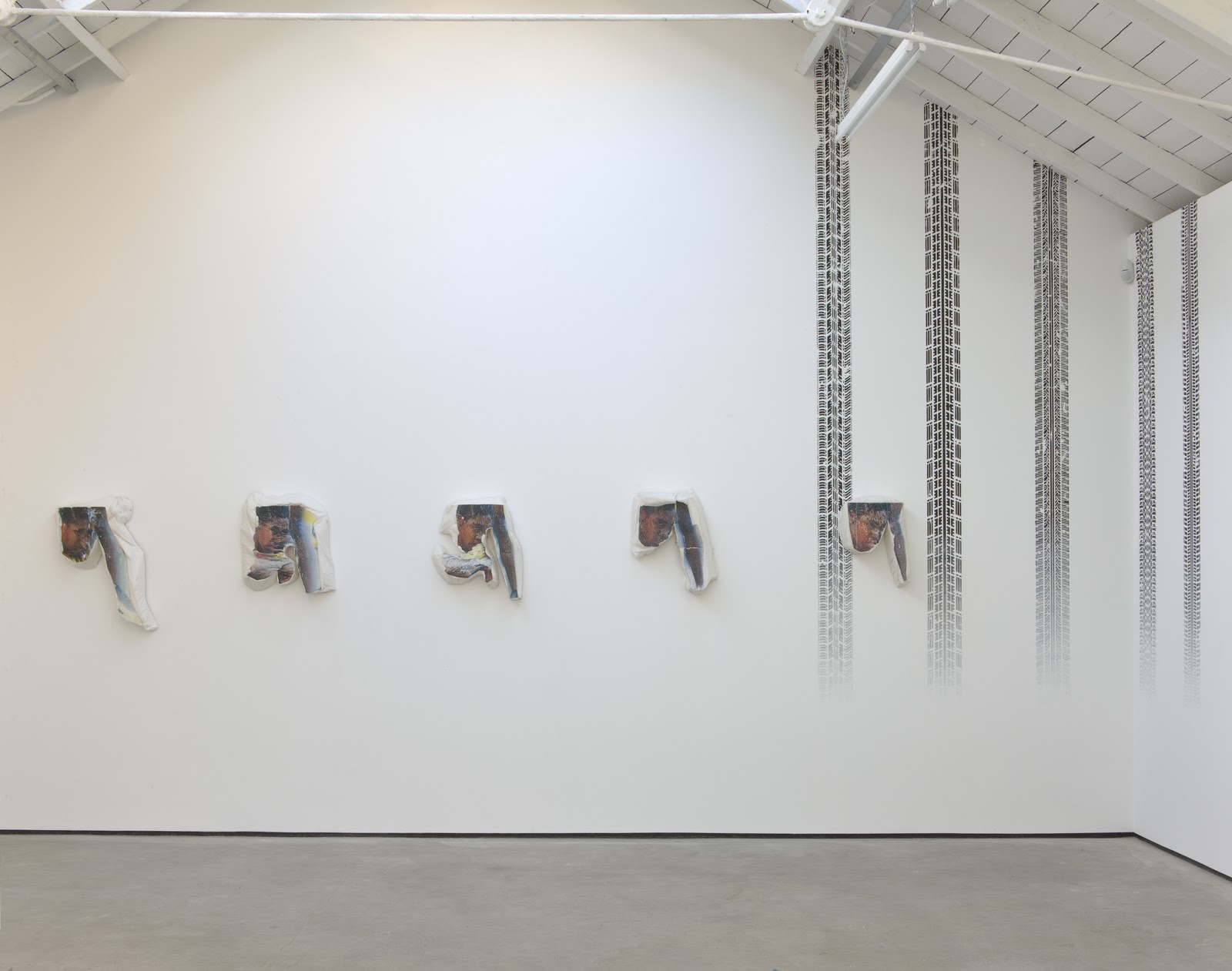
Alex Dordoy's work exists at the threshold of completeness and often retains the potential for change, or even destruction. Using materials including glass and plaster, on occasion the glass is broken or the plaster precariously vulnerable. Dordoy's current exhibition at The Modern Institute, Glasgow, includes a series of paintings on canvas and wall mounted plaster objects. The new paintings are based on the image of a figure in the landscape, with the form digitally re-worked and then meticulously reproduced in paint by Dordoy to create what he describes as highly worked photorealist, psychedelic mindsapces. The plaster objects will include objects based on the figure's head, and also several Folded, Unfolded, Sunk and Scanned works which take their shape from an unfolded paper aeroplane. Here Dordoy talks to us about his work and his plans for the future.

BR: This will be your third exhibition with The Modern Institute. How did you first get involved with the gallery?
AD: We started a dialogue at my Glasgow School of Art degree show in 2007. This led to the solo show Winner in 2009, in The Modern Institute’s old space on Robertson Street in Glasgow.

BR: This show includes a series of paintings on canvas and wall mounted plaster objects. When did you first begin working in this medium?
AD: I have always shown paintings along side wall mounted and free standing objects. In the simplest terms this comes from a desire to expand painting’s 2-dimensional space out into the physical world. The first plaster work was a head cast, Forever for Nothing (2009), shown in Winner. This opened up the possibility of an object being structurally composed of the trace of something, as opposed to a thing in itself; I find this slippage fascinating.

BR: Do you feel working in this way gives you more freedom to be expressive than a painting perhaps would?
AD: The new plaster works use a technique that I have developed in which toner is transferred from a laser print to the plaster surface. This allows me to turn digital information – found information – into a found object. For example, the ‘heads’ in the show, Paradise of New Age 1-5, all have variations of a digitally manipulated image of the runner Caster Semenya transferred onto a plaster supports moulded from plastic bags. The billowing folds of plaster echo the surfaces depicted in the image and thus serve as shorthand for human flesh.

The idea of an art work being expressive is problematic as it places total emphasis on the artist at the expense of the agency of the viewer and object. I believe that a work functions when it creates an emotive charge in the viewer (as distinct from conveying an emotion); by which I mean an understanding that matter can also be an idea, which really has nothing to do with the artist. The plaster works are liberating because of the ease with which they eliminate me from the equation.

BR: How important do you think traditional forms are in our digital age?
AD: The new paintings are composed on Photoshop. The process is as intuitive as making a collage with paper and glue yet allows for far more complex image manipulation and layering of information. It is quick and there is an undo button. I designed the three paintings to work as a series, with certain motifs repeated between them, and titled them accordingly: Four Times Around the Sun, A Halo of Mist as a Warning, The Clouds of my Youth and Dreams are Gone. At this point, they could have just been scaled up and printed out. Painting them, however, fuses a much denser form of time into the surface and generates pathos from my inevitable failure to function as a printer. Painting is additive and hence the physical inverse of the plaster work. I believe that polarity is important to the show.

BR: Did you always want to become an artist?
AD: Yes

BR: What are you working on now?
AD: A publication covering the works in the gallery (and painting my flat).

Alex Dordoy, 14/01/2012 - 22/02/2012, The Modern Institute, 14—20 Osborne Street, Glasgow, G1 5QN. www.themoderninstitute.com

Aesthetica in Print

If you only read Aesthetica online, you're missing out. The December/January issue of Aesthetica offers a diverse range of features from The Way We Live Now, which is on at the Design Museum, London, to Anselm Kiefer opening at Tel Aviv Museum of Art, to a look at Danser Sa Vie at Pompidou Centre, which examines the place dance holds in art history. Plus it comes with its very own DVD of short films from the Aesthetica Short Film Festival.

If you would like to buy this issue, you can search for your nearest stockist here. Better yet call +44 (0) 1904 629 137 or visit the website to subscribe to Aesthetica for a year and save 20% on the printed magazine

Caption:
Alex Dordoy
Installation view
The Modern Institute/Toby Webster Ltd, Glasgow
Courtesy the artist and The Modern Institute/Toby Webster Ltd, Glasgow
Photography by Ruth Clark

Monday, 23 January 2012

The Fundamental Collaboration between Maker & Material | Formed Thoughts | Jerwood Space | London


Text by Karla Evans

There are certain exhibitions whose titles are so ambiguous and nonsensical that even before attending the show you are met with a quiet sense of dread on whether you will get it. Don’t let that opening sentence put you off this one though. The Jerwood Space’s remotely vague title of Formed Thoughts does give off a whiff off indeterminate expectation but what it lacks in an enticing name it makes up for in an intriguing collection of works on a subject matter rarely discussed.

The exhibition is curated by British artist, Clare Twomey known for her unashamedly pretty ceramics and site specific installations that have appeared everywhere from London’s Tate Modern to The National Museum of Modern Art, Kyoto, Japan. For Twomey the show appears a labour of love focused on her preferred subject matter of site-specific work involving diverse materials and highlighting the oft forgotten processes that have helped the works into their finalized forms. Phoebe Cummings shows a special inkling towards clay and its disintegration; two-person design team Glithero use fire as a means to an artful end; and Tracey Rowledge works directly onto the gallery’s very walls. Oil paints and movable easels, you won’t find here.

For a site-specific space London boasts no better establishment than the Jerwood; its glass ceiling atrium is perfect for Rowledge’s epic granite work that is plastered on to a long, lone wall demanding your attention on entering the gallery. Look close enough at the appropriately named Surface and it seems the material has been scratched away at with the side of a coin giving off reflective glimpses in its indentations. It’s a work that speaks of the burgeoning New York artist Jacob Kassay whose silvery paintings distort the surroundings in a very similar way. The harder you look at Rowledge’s reflective surface the less you see, we are no longer solid human forms but swashes and swirls of colour. One can’t help get carried away whilst trying to find themselves within the shimmering mass.

Formed Thoughts’ most mesmerizing work comes from the video and canvas project from Glithero. The two borderline pyromaniacs have continued on their 2011 project Burn, Burn, Burn in which they outlined patterns in flammable screen-printed paint, set them alight and allowed the fire to burn out across the works leaving a charcoal streak of the initial, often very beautiful, motif. This time they brought a little more drama to the table with a video installation showing the process itself; fire slowly burning out along the assigned maze. The result was mesmerizing. Even amongst the hustle and bustle of a complimentary wine-fuelled opening you couldn’t help but stop and stare at the work, captivated. It appears our ancient awe of fire has never left us. The idea that something so destructive and wild as fire has created something so aesthetically pleasing and orderly is not ignored. And Buddhist-like it nodded to reincarnation; by destroying one thing, we create something else in return.

It was Phoebe Cummings’ that gave off an all-together very different atmosphere. Last year’s ceramicist-in-residence at the Victoria and Albert museum was spot on when she said; “however intricate and detailed the works may be, they can always be reduced in essence to mud.” The vaguely nautical theme felt sinister with rotting chains hanging from the ceiling alongside an unsettling, flaking pile of clay pancakes. Two fish tanks appeared at opposite sides of the room; one containing dried out, disintegrating coral and the other half full of wet cement. All of which were oddly disquieting for such seemingly simple works. Cummings is challenging the notions of ceramics– usually such a personal craft, something you can take home and set upon your wall. But here ceramics were temporal pieces melded into the gallery walls and being encouraged to dismantle themselves in the space itself. The charm is that these works are not suspended in a moment of time but constantly changing.

Lover or hater of these rarely used mediums this is an exhibition that may not pull you in at the off but spend a little time to quandary the works and you may find your own presumptions of art being disputed.

Jerwood Encounters: Formed Thoughts, 18/01/2012 - 26/02/2012, Jerwood Space, 171 Union Street, Bankside, London, SE1 0LN. www.jerwoodvisualarts.org

Aesthetica in Print

If you only read Aesthetica online, you're missing out. The December/January issue of Aesthetica offers a diverse range of features from The Way We Live Now, which is on at the Design Museum, London, to Anselm Kiefer opening at Tel Aviv Museum of Art, to a look at Danser Sa Vie at Pompidou Centre, which examines the place dance holds in art history. Plus it comes with its very own DVD of short films from the Aesthetica Short Film Festival.

If you would like to buy this issue, you can search for your nearest stockist here. Better yet call +44 (0) 1904 629 137 or visit the website to subscribe to Aesthetica for a year and save 20% on the printed magazine

Photography: Tomas Rydin

Friday, 20 January 2012

Physical Manifestations of Information | Merseyside's Leo Fitzmaurice wins Northern Art Prize


The fifth annual Northern Art Prize, worth £16,500, has been won by Merseyside-based artist Leo Fitzmaurice, it was announced at Leeds Art Gallery last night. Three remaining short listed artists; Liadin Cooke, James Hugonin and Richard Rigg each walk away with £1,500. Not bad for a Thursday night in Leeds.

In choosing Fitzmaurice as the winner, the judges commented: "The strength of this year's exhibition and the Prize are testament to the generosity and commitment of all the artists. However, Leo's work for the Northern Art Prize exhibition in particular is ambitious, risky and compelling. Drawing upon historic resources and current mobile phone technology, he provides a fresh perspective on the traditional subject of landscape, whilst at the same time pushing the boundaries of his own practice."

Fitzmaurice, who lives and works in The Wirral, is known for his witty installations and sculptures. The Way Things Appear, a collection of photographs of objects and graphical elements taken in their everyday setting, is presented for the first time as a digital slide show for the Northern Art Prize exhibition. The initial piece of design, for example a sign or iron railing is captured in the photograph and then repeated or mimicked by other objects nearby or, in some other way, made strange by its situation.

Fitzmaurice also presented Horizon,(Leeds) as part of his Northern Art Prize selection, originally displayed with pieces chosen from the Grundy Art Gallery collection. For the Northern Art Prize exhibition he selected landscape paintings from the Leeds Art Gallery permanent collection creating a new piece of work by lining up the historic works to create a continuous landscape. This work continues Fitzmaurice’s fascination with relationship between graphic design, landscape and objects and their relation to language.

Northern Art Prize, 25/11/2011 - 19/02/2012, Leeds Art Gallery, The Headrow, Leeds, LS1 3AA. www.northernartprize.org.uk

Aesthetica in Print
If you only read Aesthetica online, you're missing out. The December/January issue of Aesthetica offers a diverse range of features from The Way We Live Now, which is on at the Design Museum, London, to Anselm Kiefer opening at Tel Aviv Museum of Art, to a look at Danser Sa Vie at Pompidou Centre, which examines the place dance holds in art history. Plus it comes with its very own DVD of short films from the Aesthetica Short Film Festival.

If you would like to buy this issue, you can search for your nearest stockist here. Better yet call +44 (0) 1904 629 137 or visit the website to subscribe to Aesthetica for a year and save 20% on the printed magazine.

Photography: David Lindsay

Blog Archive