We've moved


The Aesthetica Blog has moved:


Wednesday, 14 September 2011

An Unending Series of Connections | Lost in Lace | Gas Hall | BMAG, Birmingham


Lost in Lace is the first exhibition programmed through the Craft Council's biennial Fifty:Fifty scheme, through which the Crafts Council co-funds and co-produces an exhibition with a partner organisation chosen by open selection. Speaking about the partnership, Rosy Greenlees, Executive Director of the Crafts Council: "We are thrilled to be working with the BMAG on this exciting inaugural Fifty:Fifty exhibition. Lost in Lace will encourage people to think about the fabric of the spaces we live in through extraordinary textile pieces created by prolific international artists. We believe this will draw new audiences to see the sort of contemporary craft that they may have never seen before."

Organised by Professor of Textiles at University for the Creative Arts (UCA), Lesley Millar, this show features 20 leading international artists, and will explore the relationship between textiles - specifically lace - and space through a series of dramatic and ambitious new site-sensitive installations. The exhibition brings together both leading and emergent artists and makers - many of whom will be exhibiting in the UK for the first time. From the intricate to the monumental, these contemporary works will challenge the viewer's existing notions of space, encouraging them to renegotiate the mysterious new environments and blurred and shifted boundaries that emerge.

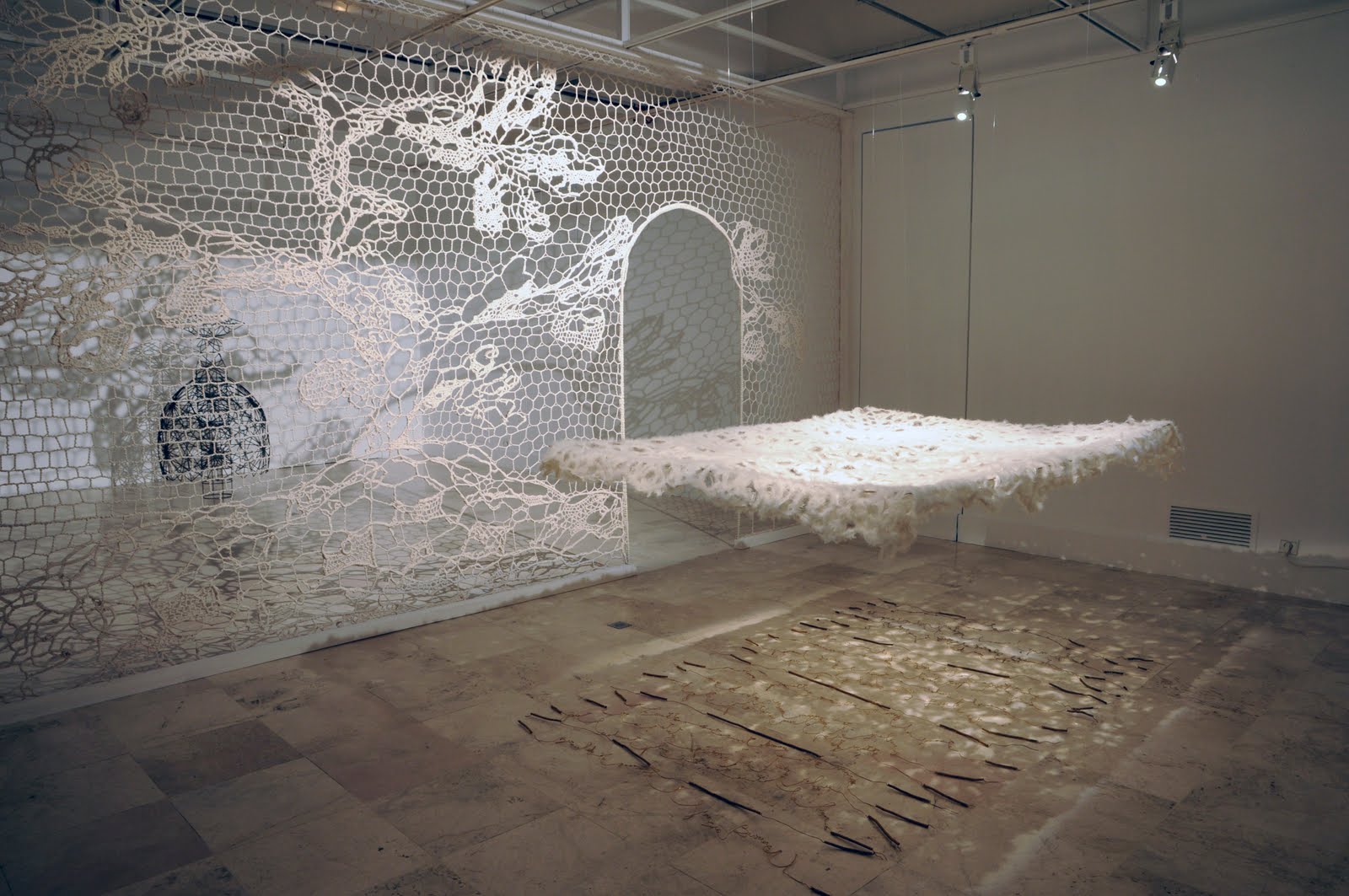
The work exhibited spans a diverse range of materials, practices and inspirations. The work exhibited spans a diverse range of materials, practices and inspirations. Atelier Manferdini will present a stunning inverted crystal cathedral hanging from ceiling to floor. Other large-scale works include acclaimed Japanese artist Chiharu Shiota’s web of interlacing black thread, eerily entrapping a white staircase. French artist Annie Bascoul’s dual installation evokes a more sensual environment: an intricate cotton screen casts beautiful shadows across the floor as a delicate bed of feathers floats above the text of an erotic poem.

Leading British maker Michael Brennand Wood will explore his anti-militaristic sentiments in his series of red and black aluminium roundels, connected in a constellation-like pattern. Lise Bjørne Linnert’s Fences also raises political issues, as each photograph depicts an area of fence she has embroidered to highlight a hole. Often undertaken in conflict zones, her work investigates the notion of these contentious boundaries.

The exhibition will also see a number of artists that employ detailed scientific process and knowledge in their work. Tamar Frank’s grid of phosphorescent threads will glow to reveal complex 3D parabolic curves, whilst the lace-like pattern stencilled onto Alessia Giardino’s photo-catalytic concrete panels is developed through their exposure to airborne pollution, and Kathleen Rogers uses new microscopy equipment to expose thread structures.

These, alongside many other new and exciting works, will provide an immersive and multi-sensory experience for the viewer, and reveal the radical new approaches to textile and space made by artists and makers around the world.

The exhibition is accompanied by a fully illustrated catalogue containing background information and interviews with the participants, edited by the exhibition curator Lesley Millar MBE. Parallel to Lost in Lace, BMAG presents an exhibition focussing on the research, reinterpretation and redisplay of their historic lace collection.

Lost in Lace is at the Gas Hall at Birmingham Museum and Art Gallery from 29 October to 19 February 2012.

lostinlace.org.uk
bmag.org.uk

Aesthetica Magazine
We hope you enjoy reading the Aesthetica Blog, if you want to explore more of the best in contemporary arts and culture you should read us in print too. You can buy it today by calling +44(0)1904 479 168. Even better, subscribe to Aesthetica and save 20%. Go on, enjoy!

Image:
Moucharabieh and Jardin de lit, lit de Jardin
© Annie Bascoul

Tuesday, 13 September 2011

Equality, Accessibility, Availability | Doug Jones | Caeteris Paribus | ASC Gallery | London


Doug Jones’s new series of work revolve around issues of equality, accessibility and availability. Through the media of video, installation, needlepoint embroidery and quilt-making, Jones’ show Caeteris Paribus (everything else being equal) weaves together experiences of personal failure of involvement in public events, irreverent comments on British heritage production and observations on ubiquitous patterns of restriction inscribed in the social arena by legislative mechanisms and police jurisdiction.

To accompany the exhibition, a catalogue has been produced which includes an interview between the artist and the writer Anna Castelli. ASC Gallery have kindly allowed us to reproduce this conversation below.

Doug Jones in conversation with Anna Castelli, London, 2011.

One of the last times I saw Doug, he showed me on Google Earth a dead-end street next to Morrison’s car park in Peckham. Quite random, I thought. I know the area quite well since I pass it every day on my way to work. It is one of those non-places. Those spaces that feel like no-man’s land, where there is no past and no present. Where you would not imagine anything has ever happened. Doug informed me that evening that he recently discovered his family began there. In a house that was bombed and destroyed by the German Luftwaffe in a night raid during the Second World War. Every day I pass the car park now, the landscape is not the same. It has become a place that has a past, a history, a heritage.

Anna Castelli: Starting from the title that you have selected for this exhibition, Caeteris paribus, (Other things being equal) tell me more about the body of works you are showing on this occasion.

Doug Jones: In Caeteris paribus I am presenting a series of works which revolve around ideas of equality, accessibility and availability. There is a new development on a series of needlepoint tapestries on which I have been working since 2007. Other works presented will be videos and installations/sculptures that I produced during the last few months. The video Royal Wedding records my experience of trying to attend Kate and William’s marriage. A second video focuses on public water fountains in Venice. The installation pieces could be seen as soft interventions on the architecture of the gallery building and on the urban landscape. Using quilted hi-visibility material I have made a soft portable version of a Gothic cathedral’s arches.

AC: The use of the Latin language is a recurrent trait in your work, Why Latin?

DJ: I studied Latin at school when I was young. The choice of naming my works in Latin is a reference to the power of language. In fact, as soon as something is named or labeled with a Latin word, we treat it as something that becomes valuable, serious and worthy. I find that amusing.

AC: So what is the story behind the tapestry pieces?

DJ: The needlepoints are found objects on which I intervene. I have a passion for this sort of tapestry
because for me they are classic symbols of quintessential Britishness. They are symbols of British tradition and identity. The subjects I choose, such as old picturesque villages, little cottages and beautiful countryside sceneries bring feelings of comfort and nostalgia. My intervention then becomes a way of questioning and raising issues about home ownership and exclusion in this country. It is an observation about the distribution of council houses within the population, or places like the notorious ‘Dover Immigration Removal Centre’.

AC: Dinner for Twenty appears to make a nostalgic reference to the British street parties held at the time of national celebrations such as the end of World War 2, the Queens silver Jubilee, Royal weddings and coronations.

DJ: Something similar still took place on a minor scale for the most recent royal wedding, largely governed by Health and Safety, even the old ladies making sandwiches required a CRB check… In my piece all types of events are celebrated through a vast dinner service made up of commemorative table-ware, from Coal miners’ strikes to pancake races, from banking through to Wesleys methodist movement. Being invited to this dinner party requires the guests to join up to the collective, the diners are literally tied together by their apron strings.

AC: Tell me more about the ‘Royal Wedding’ and your experience that day.

DJ: I was genuinely excited the day of the Royal Wedding. It is possibly the largest public event I will ever experience in my life and I really didn’t want to miss it. I even had an argument with my partner because she didn’t have much desire to go and cheer at the Royal couple. The video documents that day and the impossibility for me to actually take part in the celebration of the wedding. The wedding was in fact very difficult to access. Every single street leading to Whitehall and the Mall had been closed with turnpikes, barrages and tall metal fences from the early morning. A huge cohort of police officers at every gate turned crowds of people away, suggesting an entry would be possible from the next gate, where the same thing would occur. I found myself wandering in the streets of London for hours, without ever being able to take part in the public event which the entire country had been invited to attend. A moment that was supposed to be available for everyone, and was also paid by everyone with tax money, has once again ended up being just for the few.

AC: There is a fundamental critique of society in every one of your works. Is this just a critique of the British government and people or maybe a more extended comment about human beings and (the) Western society?

DJ: suppose when you start thinking about issues and problems that you wish (or have the
will) to address you always start from home, from the things that are more familiar to you. Although I am not sure I would use the word critique to define what my work does. I prefer to say that I make observations.

AC: And how about the irony that lies behind such interventions?

DJ: Again, I don’t think there is irony. I don’t like the word irony and I don’t really know what it means. I think that my work is slightly rude and maybe a little revengeful. It is my bad mannered answer to the conventions I grew up with and that are part of my cultural heritage.

AC: Can we say that your work is maybe….irreverent?

DJ: Yes, I like that. I like irreverent. I like being irreverent, playing with imagery that used to impress me and transfix me as a child. This is why I enjoy tying up old ladies…

AC: And how about Datur omnibus then. This is the only work that is not strictly connected with British culture. How does that fit in?

DJ: I recently spent a week in Venice, mostly wandering around looking at the architecture in the boiling heat. Thirst made me notice just how many public water fountains were there. The quest for cold running water started to guide my steps through the city.Bottled water in Venice is very expensive and therefore unaffordable in the quantities you need to keep hydrated. Also in June, the Italian people have been voting for a referendum against the water privatization. Filming people using the public fountain then becomes a way to address the importance of peoples rights. The availability of water that makes you equal. But also Venice for me symbolizes the Grand Tour.

AC: Grand tour?
DJ: Yes, the Grand Tour. The traditional travel of Europe undertaken by the British upper-class’s of means. Now with low budget airlines such as Ryanair or Easyjet this has become available for the masses. Also I love to observe tourists and to see how the British behave outside the UK.

AC: So in all your works there seems to be a contradictory relationship with your cultural heritage that translates into your irreverent intervention on appropriated materials. This seems a very intimate aspect of your practice that can be quite complicated to understand.

DJ: There is something really subtle here. I can maybe explain it by going back to the Royal Wedding. My wish that day and my intention during the editing of the video was never to mock the Royal Family. I honestly wanted to be in the streets and cheer with the crowd. I was incredibly excited and genuinely looking forward to taking part. The impossibility to to so and the circumstances of the event created my work. With everything that I use, all my symbols and all my materials, my intent is never just to poke fun or be rude. I choose these elements because they are truly important to me, part of who I am. I use them to make a commentary on what surrounds me.

Doug Jones: Caeteris Paribus is on show at ASC Gallery, London until 21 October.

ascstudios.co.uk

Aesthetica Magazine
We hope you enjoy reading the Aesthetica Blog, if you want to explore more of the best in contemporary arts and culture you should read us in print too. You can buy it today by calling +44(0)1904 479 168. Even better, subscribe to Aesthetica and save 20%. Go on, enjoy!

Image:
Royal Wedding
Photography by Assunta Ruocco
Courtesy of Ceri Hand Gallery.

Monday, 12 September 2011

I Can't Go On. I'll Go On | Ursula Burke | PS2 Project Space | Belfast


Text by Angela Darby

The PS² in Belfast is a gallery dedicated to platforming projects and exhibitions of an experimental socio-political nature. Through this open-ended approach the curator, Peter Mutschler and curatorial adviser Ruth Morrow have attracted a high standard of proposals to the gallery’s program. The current exhibition by renowned artist, Ursula Burke I can’t go on. I’ll go on confirms their vision.

The exhibition’s title is derived from Samuel Beckett’s novel The Unnamable (1953). The two statements, taken from the closing lines of the protagonist’s narration, sit in polarized opposition to one another yet present a stoic assertion in the face of despair. This sense of ambiguity is also evident in the works on display.

On entering the gallery space one encounters thirteen wooden armatures protruding from two facing walls. Each holds a small-scale porcelain sculpture in their outstretched ‘palms’. With the works free from the hindrance of a glass case the viewer can move around each one, allowing greater intimacy. The style in which this display is presented evokes images from Cocteau’s classic film version of the fairytale La Belle et Le Bête (1946). In the Beast’s castle utilitarian objects become animated and in one scene human arms stretch from the walls holding candelabras to light the way. The domestic scale of these reconstructed ornaments intensifies the sense of rage directed towards all social repression that is reinforced within the home.

The first sculpture is of an auburn haired porcelain doll named Rua, the Gaelic word for red, and she heralds the starting point in the exhibition. The doll’s face is decorated with rows of small pink roses, covering the mouth, nose and cheeks. Even though Rua is clearly stifled and masked by these decorative barnacle-like flowers, she still has a story to tell. The pale pink roses seem symbolic of an adolescent girl who has yet to blossom into womanhood. The child that Rua represents is stifled by social expectations in relation to being female, external assumptions about innocence and emergent sexuality repress her. Comparisons can be drawn with Angela Carter’s modern adaption of the red riding hood character Rosaleen, in the novel The Bloody Chamber(1979). The author’s collection contemporizes classic fairy tales to address female sexuality; in particular the pubescent, liminal stage between childhood and adulthood. The artist perhaps places Rua in the same context as Carter’s Rosaleen, personifying the affect of socially repressive morality that patriarchal religious restrictions have placed upon the female body.

Folklore, fairytales and the re-telling of myths underpin the thematic structure of the exhibition. One myth indoctrinated by the Catholic Church is the ‘sinless’ conception and birth of Jesus by the virginal Madonna. Burke has appropriated the iconic statue of the Virgin Mary depicted with her arms outstretched, palms turned outward and head lowered in a gesture of passive acceptance. The artist conceals this ‘vessel’s’ face and regales her customary blue and white garments with an exquisite white porcelain shroud that has been decorated with small shamrocks. At her feet a pair of Converse baseball shoes have replaced the serpent and the rose. In Modern Mary, the statues significance has been diminished to a national tourist symbol one which is bound up in the old patriarchal order and equivalent to other consumerist icons. It is no longer relevant to the expectations of a woman living in contemporary Ireland.

Throughout the exhibition Burke formulates a storytelling narrative that comments on the deconstruction as well as reconstruction of an Ireland past and present. Failte presents a small vignette on the demise of a romanticized rural Ireland. A decapitated farmer stands, head in hand, flanked by the unsympathetic figure of a suited real-estate agent and a chicken farmer who is sinking fast into a bog surrounded by his drowning flock. The aptly titled piece Safe as Houses brings into play the cautionary tale of the three pigs as a caveat to the collapse of the building industry. In The Burden a female Minotaur with a golden head sits saddled with a house strapped to its back. The combination of this pagan demigod’s masculine head transplanted onto the torso of a fragile porcelain doll’s body is a perfect example of the ambiguity mentioned earlier. The hybrid form contains within it a duality heavy with symbolic resonance. The weight of domesticity exhausts both the corporeal and the divine.

The last work in the series, Portrait of an artist-After Artemisia Gentileschi, sits in direct conversation with its opposite number Rua on the adjacent wall of the gallery. A now adult figure is still hampered by expectations placed on the female and she is burdened by her chattels; a designer bag, mobile phone and camera. Her back is stooped, and a large rat is riding on her back whilst another peeks out from under her dress. Both perhaps represent rogue parasites that become fellow travellers, latching on when we are too weary to resist. Or perhaps they echo life events that have led to the artist’s identification with a female artist of an earlier time who suffered from the chauvinism of her age. This is an exhibition rich in potent imagery and stimulating connections. There is a delight and excellence in the construction of the objects, that perfectly reflects the consideration given to the themes that underpin the collection.

Ursula Burke: I can't go on. I'll go on continues at Paragon Studios Project Space, Belfast until 24 September.

pssquared.org

Aesthetica Magazine We hope you enjoy reading the Aesthetica Blog, if you want to explore more of the best in contemporary arts and culture you should read us in print too. You can buy it today by calling +44(0)1904 479 168. Even better, subscribe to Aesthetica and save 20%. Go on, enjoy!

Image:
Ursula Burke The Burden (2011)
Courtesy the artist

Blog Archive