We've moved


The Aesthetica Blog has moved:


Monday, 20 December 2010

Review: Joy Gregory - Lost Languages and Other Voices


Review by Ceri Restrick

Lost Languages and Other Voices is Joy Gregory’s first major retrospective. The exhibition charts the artist’s career over two decades and confirms her position as one of the most important artists to emerge from the Black British photography movement of the 1980s. The title of the exhibition refers to the works Gomera (2008) and Kalahari (2010) in which Gregory highlights the cultural importance of marginalised African indigenous languages. Split into 14 sections, the show deftly explores themes of identity, gender, race, post colonial identities and stereotypes, and while the topics are intense, Gregory’s tone and presentation are quite the opposite. Her use of text combined with video installation explores these concepts in a skillful, honest and playful manner. Her sense of humour and sardonic wit are particularly evident in Journey to Kuona (2009) and Six Weeks (2009).

Journey to Kuona takes shape through a series of blurred photographs, which are printed onto foam canvas-board, and slotted together like a panorama, each photo varies slightly; a dirt track road, red soil and creamy white villas are unassumingly juxtaposed. Refreshingly, there is no accompanying text, the photographs take the air of documentary transcending the boundaries of fine art, however Six Weeks brings the sweet sound of clarity to this torrent of imagery. A collection of scribbled notes and doodles are traced onto 42 scraps of paper, and as the viewer follows the spider-like handwriting and cartoon diagrams a narrative and journey unfolds. The story goes likes this; Gregory was invited to Nairobi to be Artist in Residence at the Kuona Trust. She then realised she had forgotten the charger for her camera. Not to be thwarted, her mobile phone became her camera and pen and paper became a tool for documentation.

The blurred photographs and scribbled notes are poignant, acting like a diary of the artist’s experience. This creates an immediate relationship between the artist and the viewer, making the work all the more so personal and relevant. The notes give the still images depth, movement of thought and offer an acute observation on the creative processes. The text re-assembles specific and transitory moments that occurred between each shot, resulting in the mapping of Kuona.

Autobiographical work is often criticised for being self-indulgent and can be used as an excuse to skim over technique and quality. However, Lost Languages does not fall into this pit. Gregory uses her personal experiences to ask key questions which not only provoke, but evoke debate. Bottled Blonde (1998) examines the complexities behind the female desire to be blond and the associated racial implications. Sites of Africa (2001 – present) documents the relationship that London had with the African continent and the notion of absent histories. Throughout the exhibition it is striking to notice how many continents are represented in Gregory’s collection; Europe, Africa, Asia and the Americas. Such is the richness of this exhibition that it requires several visits to absorb everything that Gregory has to offer. This shouldn’t be a problem though, since, like all good things in life, entry is free.

Lost Languages and Other Voices continues at Impressions Gallery until 19 February 2011. Opening Times Tuesday to Friday 11am to 6pm. Late openings Thursdays until 7pm. Saturdays 12pm to 5pm.

www.impressions-gallery.com

Image: (c) Joy Gregory from Kalahari, 2010

Friday, 17 December 2010

Review: Fresh Hell at the Palais de Tokyo, Paris


Review by Rosa Rankin-Gee

There is something life-affirming about the queues to see art in Paris. Perennially long, and slow, and full of people complaining in a buoyant way. I was having a great time, until I realised I had actually joined the queue out of fondness rather than necessity, and was about to see Larry Clark at the Musée d'Art Modern for the second time in a week.

The Palais de Tokyo is just next door. Same egg-coloured building, different interior: hamster tubes, strip lighting and the famous fotoautomat. Fresh Hell sees the Palais give curation carte blanche to Adam McEwen, the New York-based British artist best known for his obituaries of the living, and turning chewing gum and text messages into artworks.

A privilege thus far only afforded to Ugo Rondinone in 2008 and Jenny Deller in 2009, the carte blanche is intended to map the artist’s brain, desires and influences. McEwen’s Fresh Hell is his dance through history, “unfettered” by chronology. Or, as it turns out, cohesion.

Visitors are greeted by three of the heads of the Kings of Judah, brutish 13th century relics lopped off the facade of Notre Dame by an angry mob during the Revolution. Directly behind them, the pointedly distracting backdrop of Rudolf Stingel’s tin foil wall, scratched with love hearts, and studded with paper planes and stabbed-in pens. The exhibition’s sense of self is perhaps clearest here: sabotage old and new, meaningful and less so.

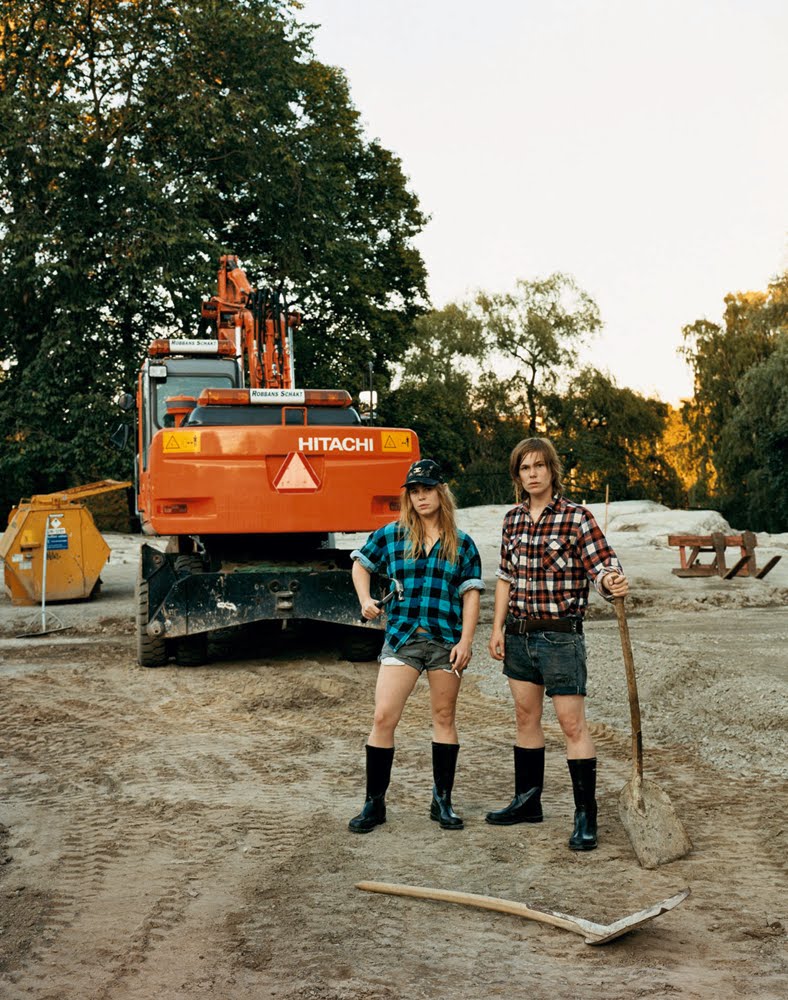
Yet, also sharing the room is the cover image of the exhibition, Hanna and Klara Liden’s Sisters: two girls with thick knees and black rubber work boots. An arresting photograph, which deserves attention, it is out of sync with its roommates and thus nearly lost. This is characteristic of the show as a whole: it is a curiously strung necklace where mismatched beads weigh down the thread to breaking point.

Room two jerks us into Michael Landy’s Market, mini mountains of plastic crates draped with fake lawn carpets, a grocer’s market bereft of stock or customers. A statement about Thatcherism, the art market or economic recession, the 1990 installation (from the heyday, like many of the exhibits, of the YBA) declares itself ‘despairingly empty’, but this just seems like a perfunctory attempt to pre-empt criticism.

Fortunately, Hell gets a bit hotter with Anna Mendietta’s oddly touching self-portraits of her naked body straddling a skeleton, and Bruce Nauman and Frank Owens’ Pursuit, a film of 15 different people running, shot in disorienting, shaky-handed close-ups to a claustrophobic soundtrack of pounding feet and short breath.

Theoretically, the show skates through six stages: “genealogy”, “consecration”, “Danse Macabre” and “pilgrimage”, finishing with a dose of “mescaline” and finally “cemeteries”. These themes are borrowed from HC Westerman’s Connecticut Ballroom Suite, a bright and delicate sextet of woodcuts which nod to muralism, Dali and even Pop-Eye. Westerman’s six-piece Suite comes too late in the show however, and too understatedly, for its influence on McEwen’s curation to seem like anything other than a strapped-on afterthought. In fact, one theme, not six, emerges. The relentless runners, a transparent maze, a broken-into safe: futility is the order of the day. Sarah Lucas’s Is suicide genetic’ - a burnt armchair, throne to a motorcycle helmet made out of Marlboro Lights – neatly sums up the leitmotif.

In fairness, there are also moments of great playfulness (Barbara Bloom’s Playboy for the Blind: Marilyn Monroe seductively reading Ulysses on one page, a Braille description of the image on the opposite) and also fine workmanship. A late 15th century wood statue of Saint Florian, pin pricked with wood worm, is just beautiful. This is the problem: the water Florian pours onto a burning building is captured so well in wood that it makes one crave skill, and feel somewhat despondent about the ‘modern’ pieces that surround it. For example, Jessica Diamond’s Is That All There Is?, which poses the question atop a Clip Art image of the world, and Angela Bulloch’s flashing Belisha Beacons which are... exactly that, unadorned and unfortunately placed close to Martin Creed’s Work no. 925: 4 chairs, stacked together. Futility once again, and ferociously self-aware of course, but still, this is the type of art that won the YBAs their critics.

McEwen finds it exciting “when one work is allowed to generate friction with another.” Agreed. And flamboyant juxtaposition clearly lies at the heart of Fresh Hell. Yet there comes a point where ‘anarchic’ or ‘sprawling’ just become nice ways of saying ‘messy’ and, ultimately, ‘confused’.

McEwen’s only personal contribution to the exhibition comes very near the end. Hommage to Sigmar Polke – a scribble on the wall done with blue and cream masking tape which vaguely depicts a human form. Yes, there is certain irreverence, and a charm in the way the simple lines echo the cracks on the Palais’ shiny cement floor. However, like the overarching effect of the exhibition, it left me indifferent.

You exit the exhibition through Agathe Snow’s Yes, a wall full of a word which is perhaps deliberately inappropriate. Many will walk out of McEwen’s carte blanche with a question in mind rather than an answer: what Fresh Hell is this?

Rosa Rankin-Gee
Writer, and Editor of A Tale of Three Cities www.taleofthree.com, the first arts journal to join up the dots of London, Paris and Berlin, and Alight here: The Tube Project www.alighthere.co.uk

Fresh Hell contines at the Palais de Tokyo until 16 January 2011. www.palaisdetoyko.com


Image
Hanna & Klara Liden, Untitled (Sisters), 2006. Colour photograph, 101 x 76 cm. Courtesy of the artists.

Thursday, 16 December 2010

About A Minute – The Gopher Hole, London


Review by Carla MacKinnon

The Gopher Hole is a brand new venue and project space nestling beneath El Paso Restaurant at 350-354 Old Street in London. It's a cosy basement venue but the gallery's founders - aberrant architecture and Beatrice Galilee - have big plans for it. With an interest in “popular culture across borders”, The Gopher Hole looks to curate ideas and to facilitate critical debate on contemporary culture, the arts and society. The venue promises a diverse programme, from exhibitions and film screenings to interdisciplinary events and discussion.

Last Thursday, The Gopher Hole opened its doors to a small army of smart looking East London art lovers for a private view of its inaugural exhibition – About A Minute. The show takes as its starting point the increasing speed and availability of information, images and data and the correlating shortening of the common attention span. In a culture communicating through 140-character tweets and absorbing knowledge by skimming the ocean of information available at the touch of a button, sustained focus is increasingly rare. In the gallery context this can prove a frustrating challenge for curators. Should an artist respond to the needs of an increasingly skittish and time-poor audience, even at the expense of subtlety or detail? Must artists learn the tricks of advertisers and marketeers to compete with the noisy razzle dazzle of the city for public attention?

In About A Minute a selection of artists, designers, architects and writers respond to “a minute”, presenting a varied and lively take on the theme. The gallery is littered with compelling objects, all vying for the fickle attentions of the visitor. An old cassette player is screwed to a wall invitingly. When the play button is pressed the listener is treated to a minute long spoken word piece by poet Luke Wright, describing all the things that happen simultaneously “in the time it took you to tell me what I already knew”. The choice of the analogue, old school medium is a nice touch. After listening the visitor is instructed to wind the tape back, a reminder of magnetic tape's reassuringly physical method of capturing a period in time. Ralf Pflugfelder's striking conceptual piece The New Minute Society proposes a new kind of minute – one consisting of just 48 seconds. Wonderfully simple, the work consists of a digital clock running this new form of measuring time, alongside an oddly convincing (while entirely absurd) text encouraging viewers to sign up to the New Minute Society and enjoy the benefits, which include more leisure time and a longer lifespan. Elaine W Ho's Getting Cold This Time of Year invites the visitor to take away a watch face with no minute hand. Hundreds of these tiny, ticking objects wait in a box for the hungry hand of the gallery-goer, ever keen on an exhibition souvenir. In an adjacent box, however, is a collection of typed cards laying out a set of slightly oblique conditions to adhere to if you choose to take one of the devices. These include the avoidance of references to time in conversation, or to any discussion of 'meeting up again, talking soon or staying in touch'. The watches live on it the pockets of the visitor, a ticking reminder of these suggestions. Whether anyone will adhere to the requests on the card is questionable though the pleasing, if largely useless objects are satisfying in their own right.

There are over a dozen more artworks in this diverting and diverse show, which is well worth a look in. It is playful and not too precious, an engaging sketchbook of ideas. The most exciting element is in the curation of the contributors, cutting-edge practitioners from a cross-section of disciplines. This variety of voices seems central to The Gopher Hole's cultural mission, and the result bodes well for this colourful new project space.

About A Minute runs until 13 February 2011. www.holygopher.com

Blog Archive